
Yes, Udimi is safe — it is a legitimate solo ads marketplace that has operated since 2013 and is not a scam. However, "safe" and "high-quality" are different things. Udimi's traffic quality varies enormously between sellers, and its rating system has known limitations.
It is a reasonable starting point for absolute beginners, but experienced solo ad buyers typically migrate to trusted individual vendors where traffic quality is more consistent and personalized support is available.
What Is Udimi?
Udimi is a solo ads marketplace — a platform where people who own email lists (sellers) and people who want to buy traffic (buyers) connect in one place. Founded in 2013, Udimi is the largest and most well-known dedicated solo ads marketplace in the world, with tens of thousands of registered sellers and hundreds of thousands of buyers.
The core model is simple: a buyer selects a seller, sets a click volume and budget, and the seller sends the buyer's ad or link to their email subscriber list. Udimi handles the transaction, provides basic fraud filtering, and stores a history of buyer reviews for each seller.
Udimi does not send traffic itself — it is a marketplace that facilitates transactions between buyers and third-party list owners. This distinction is important: Udimi's quality control is limited to what its filtering and rating system can catch, and the actual traffic quality depends entirely on which seller you choose.
How Udimi Works: Step by Step
Create a Free Buyer Account
Registration is free for buyers. You enter your name, email, and payment method. No subscription is required to browse sellers or purchase traffic — Udimi earns revenue from transaction fees charged on each order.
Browse and Filter Sellers
Use Udimi's search filters to narrow sellers by niche (MMO, health, business), Tier-1 percentage, minimum order size, and buyer rating. Each seller profile shows their average ratings across multiple recent orders, niche specialisation, and sample testimonials from previous buyers.
Place an Order
Select a click volume (typically 100–2,000 clicks), set your traffic URL (your squeeze page), choose your preferred start date, and pay. Udimi holds the payment in escrow until the order is delivered, providing a basic level of buyer protection against complete non-delivery.
Seller Sends Traffic
The seller emails your link to their subscriber list over the agreed delivery window (typically 24–72 hours). Udimi's built-in tracker monitors clicks in real time and applies basic fraud filtering to remove obvious bot traffic from the displayed count.
Leave a Review
After your order completes, you can leave a star rating and written review for the seller. These reviews are visible to future buyers and form the basis of each seller's public reputation on the platform. Payment is released to the seller after you confirm delivery or after a set window lapses.
Is Udimi Legit and Safe?
Yes — Udimi is a legitimate business that has operated continuously since 2013. It is not a scam. Buyers do receive traffic, sellers do get paid, and the escrow system provides a genuine (if limited) layer of buyer protection. Udimi has a publicly registered business entity, a working dispute resolution process, and a track record of over a decade in the solo ads industry.
The question "is Udimi safe?" has two separate answers depending on what you mean:
- Safe as a transaction platform? Yes. Your payment is held in escrow, you receive clicks, and you have recourse if a seller completely fails to deliver. Udimi has processed millions of orders without systemic payment fraud.
- Safe as a guarantee of traffic quality? Not automatically. Udimi's safety mechanisms filter obvious fraud, but they do not guarantee that every seller on the platform delivers high-quality, engaged, Tier-1 traffic that actually converts. Traffic quality varies widely, and buyer outcomes depend heavily on seller selection — which is the buyer's responsibility.
Bottom Line on Safety: Udimi is safe to use in the sense that it is a real, functioning marketplace. Your money is protected against outright fraud. What it does not protect you against is mediocre traffic that does not convert — which is a quality issue, not a safety issue, and requires careful seller research to manage.
Udimi's Seller Filtering System: What It Actually Checks
Udimi applies a filtering system called Udimi Prime Filter (now integrated into the standard platform). Understanding exactly what it checks — and what it does not — is essential for setting realistic expectations about traffic quality.
| Filter / Check | How It Works | Effectiveness |
|---|---|---|
| Known Bot IPs | Compares incoming click IPs against a continuously updated database of known datacenter IP ranges, click-farm sources, and automated traffic services | ✔ Effective |
| Duplicate Clicks | Filters clicks from the same IP address within a defined time window — prevents the same visitor or bot from being counted multiple times toward your click total | ✔ Reliable |
| Geographic Tracking | Records the country of origin for every click and reports a real-time Tier-1 percentage breakdown in your buyer dashboard after delivery completes | ✔ Accurately Reported |
| Seller Behaviour Monitoring | Tracks seller complaint rates, delivery patterns, and dispute history over time — flags outliers with unusually high dispute or refund ratios for review | ⚠ Reactive Only |
| Click Speed Anomalies | Flags unusually fast bulk-click delivery patterns that may suggest non-human or automated sending behaviour rather than natural email open activity | ⚠ Partial Detection |
| ✘ What Udimi Does Not Filter or Verify | ||
| Traffic Engagement Quality | Udimi does not measure time-on-page, scroll depth, mouse movement, or any engagement signal after the click lands — a bot-free click that bounces immediately is counted as a valid delivered click | ✘ Not Checked |
| List Age or Freshness | Udimi does not verify when a seller's subscriber emails were collected, whether the list has been over-mailed, or how long subscribers have been on the list without engaging | ✘ Not Verified |
| Opt-In Rate or Conversion | Udimi does not track whether clicks convert to email subscribers on your squeeze page — conversion data is only visible through your own autoresponder or a third-party tool like ClickMagick | ✘ Not Tracked |
| Subscriber Source or Origin | Sellers are not required to disclose how or when their list was built — Udimi does not audit whether subscribers opted in legitimately or how recently they engaged with the seller's emails | ✘ Not Audited |
| Low-Engagement "Warm" Traffic | Disengaged subscribers who click from habit but never buy, open, or engage beyond the click are not distinguished from high-intent subscribers — both appear as valid delivered clicks | ✘ Not Detectable |
| Niche Audience Match | Udimi cannot verify that a seller's list is genuinely aligned with your niche offer — a seller claiming "MMO niche" may have a general mixed list with only partial audience alignment | ✘ Self-Reported Only |
 What This Means in Practice: Udimi's filtering removes obvious, known bot traffic — but it does not remove low-quality, disengaged, over-mailed, or aged list traffic that produces clicks but zero conversions. A seller can deliver 100% Tier-1, 0% bot traffic by Udimi's measurement and still produce a 3% opt-in rate because their list is exhausted or mismatched. Udimi's filter is a floor, not a ceiling.
Udimi Pros and Cons: The Honest Assessment
 What Udimi Does Well
- Legitimate, established marketplace with 10+ years of operation and buyer protection
- Large seller directory — hundreds of active sellers across multiple niches
- Built-in basic bot filtering reduces the worst-quality clicks automatically
- Buyer reviews and ratings give some signal of seller reliability
- Escrow payment model — funds held until delivery is confirmed
- Good for discovering new sellers before buying direct
- Low minimum orders accessible to complete beginners
 Udimi's Real Limitations
- Platform fee of ~20% added on top of seller price — inflates effective CPC
- Traffic quality varies enormously — no uniform standard across sellers
- Rating system can be gamed through reciprocal or purchased reviews
- No relationship with seller — no personalised advice or funnel review
- Filter does not detect low-engagement or over-mailed list traffic
- Dispute resolution is slow and often results in partial credit rather than refund
- Some high-rated sellers maintain reputation through volume, not consistent quality
The Truth About Udimi Seller Ratings
Udimi's rating system is the primary tool buyers use to evaluate sellers. Understanding its strengths and weaknesses is critical to making good purchase decisions on the platform.
What Ratings Capture Well
- Delivery reliability: Sellers who consistently deliver the ordered click volume on time tend to accumulate high ratings, and this signal is reasonably reliable. A seller with hundreds of 4–5 star reviews is unlikely to simply not deliver.
- Tier-1 percentage consistency: Reviews often mention Tier-1 percentages, and sellers who consistently deliver 80%+ Tier-1 stand out in written reviews.
- Over-delivery rates: Many buyers mention whether they received over-delivery, which is a positive quality indicator.
What Ratings Miss or Distort
- Conversion rate is subjective and dependent on the buyer's funnel: A seller who delivered 200 clicks to a buyer with a poorly written squeeze page gets a negative review — even if the traffic was high quality. Ratings conflate traffic quality with funnel quality, which are two entirely different variables.
- Rating inflation through reciprocal reviews: Some Udimi sellers and buyers have been known to exchange positive reviews or offer incentives for high ratings, particularly among newer or smaller sellers building their reputations.
- Survivorship bias: Sellers who receive very poor ratings tend to create new accounts, meaning the worst actors cycle out of the rating history while maintaining platform access.
- Recency weighting is imperfect: A seller's rating reflects cumulative history, meaning a seller who delivered excellent traffic 18 months ago but has since allowed their list quality to decline may still carry a misleadingly high average rating.
 How to Read Udimi Ratings Accurately
Look at the most recent 10–15 reviews, not the overall average. A seller with 4.8 stars overall but 3.2 stars in the last 8 reviews is declining in quality. Filter for reviews that specifically mention opt-in rates and Tier-1 percentages — these are the most objective quality metrics in buyer feedback. Ignore reviews that rate traffic based solely on whether the buyer made a sale, as this reflects funnel quality as much as traffic quality.
Udimi Pricing, Fees, and What You Actually Pay
Udimi pricing is often misunderstood because the listed seller price is not the final price you pay. Udimi adds a platform fee on top of every transaction, and optional features carry additional costs.
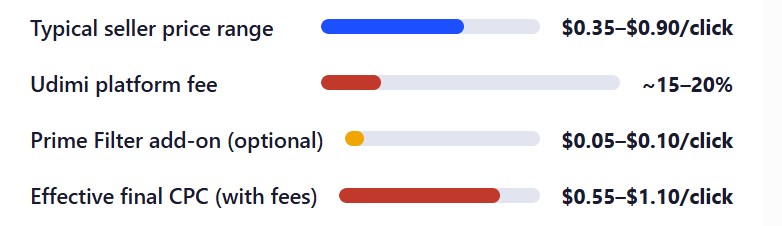
For a 300-click order from a seller listed at $0.45/click: the seller receives $135, but the buyer pays approximately $160–$165 after Udimi's platform markup. This 18–22% effective overhead is a meaningful cost, especially for buyers at the testing stage who are already working with limited budget margins.
Udimi's Membership Tiers: Udimi offers Prime membership at approximately $25/month which reduces platform fees and enables certain advanced filters. For buyers who plan to purchase traffic regularly, the membership often pays for itself through the fee reduction alone. Casual or first-time buyers typically have no reason to subscribe before testing the platform with a single order.
Traffic Quality on Udimi: What Buyers Experience
Traffic quality on Udimi is genuinely inconsistent — and this is the most important thing to understand before buying. The platform hosts sellers ranging from exceptional (25–35% opt-in rate, 85%+ Tier-1, genuine engagement) to mediocre (8–12% opt-in rate, inflated click counts, poorly maintained lists).
Indicators of a Good Udimi Seller
- Minimum 50+ completed orders with consistent recent reviews mentioning opt-in rates
- Average Tier-1 percentage above 80% as reported in recent buyer reviews
- Niche specialisation that matches your offer (MMO for make-money-online, not a general "all niches" seller)
- Response to buyer questions before purchase — sellers who engage quickly tend to be more professional
- Over-delivery record mentioned in multiple reviews (10–20% over-delivery is standard for quality sellers)
Red Flags in a Udimi Seller Profile
- Very high volume of orders with very generic reviews ("great seller, fast delivery") lacking specific metrics
- Steep discounts or prices significantly below the Udimi average — $0.20–$0.30/click is a warning sign
- No recent reviews in the last 30–60 days despite showing hundreds of historical orders
- "All niches" claim — genuine quality list owners know their audience and have a specific niche
- Reluctance to communicate or answer pre-purchase questions about list source or Tier-1 breakdown
Who Should Use Udimi (and Who Shouldn't)
Udimi Works Well For
Udimi Has Limitations For
Udimi vs Buying Solo Ads Direct: Side-by-Side Comparison
When comparing Udimi to buying solo ads directly from a dedicated solo ad vendor like Marketer Rakib, the differences go beyond price — they cover consistency, relationship, transparency, and what happens when something goes wrong.
Frequently Asked Questions — Udimi Review
Is Udimi safe? Is it legit? Does it convert? Every common question answered honestly.
No — Udimi is not a scam. It is a legitimate solo ads marketplace operating since 2013 with a functioning escrow system, dispute resolution process, and millions of completed orders. You will receive traffic when you place an order. The real concern is not scam risk but traffic quality variability — some sellers deliver excellent results while others deliver low-engagement traffic that produces poor opt-in rates despite appearing to deliver real clicks. Scam and poor quality are different problems.
Yes — as a transaction platform, Udimi is safe. Payment is held in escrow, you receive clicks, and you have recourse against complete non-delivery. However, "safe" and "high-quality" are two different things. Udimi's filter removes obvious bot traffic but does not guarantee that every seller delivers high-quality, engaged, Tier-1 traffic that converts at acceptable opt-in rates. Traffic quality depends entirely on which seller you choose — Udimi itself is just the platform.
It depends entirely on the seller. Well-vetted sellers with recent reviews mentioning 20%+ opt-in rates can deliver converting traffic. Poorly researched choices frequently produce 5–10% opt-in rates even with acceptable Tier-1 percentages. Udimi's filter removes obvious bots but not disengaged, over-mailed, or aged list traffic — which is the more common quality problem. Your conversion rate on Udimi reflects seller quality and your funnel quality equally.
Udimi adds approximately 15–20% on top of the seller's listed price as a platform fee. A seller listing at $0.45/click results in a buyer paying approximately $0.54–$0.56/click after markup. Optional Prime Filter add-ons add a further $0.05–$0.10/click. Always budget for the effective all-in price, not the seller's listed price — the difference is significant for buyers managing tight campaign margins.
Focus on the most recent 10–15 reviews rather than the overall star average. Look specifically for reviews that mention opt-in rates and Tier-1 percentages — these are objective quality signals, unlike general "great seller" feedback. Prefer niche-specific sellers (MMO, health) over "all niches" generalists. Message the seller before ordering to ask about average Tier-1 % and typical opt-in rates. Sellers who respond quickly with specific answers are generally more professional than those giving scripted or vague replies.
Yes — submit your ClickMagick tracking URL as your campaign URL on Udimi. Most quality sellers accept it. If a seller discourages external tracking, treat it as a red flag. Note that Udimi's click counter and ClickMagick will show different numbers — ClickMagick's count is more conservative and reliable for measuring real human click volume and opt-in conversions. A 3–10% difference between Udimi count and ClickMagick count is normal. Above 15% is a concern worth raising with the seller.
For absolute beginners, Udimi's escrow, review system, and dispute resolution provide useful protection. For intermediate to advanced buyers, buying direct is typically better: lower effective CPC (no platform fee), more consistent quality, a direct seller relationship, personalised support, and clearer accountability. Many experienced buyers use Udimi to discover new sellers, then build direct relationships outside the platform for ongoing orders at lower cost.
Udimi Prime is a paid membership at approximately $25/month that reduces platform fees on purchases and enables access to advanced seller filters and priority dispute support. For buyers ordering 500+ clicks/month regularly, the fee reduction often covers the subscription cost. Casual buyers or those placing a first test order should complete at least one standard order before subscribing to evaluate whether Udimi suits their needs.
Minimum order size varies by seller — some accept as few as 50 clicks, while others require 100–200 clicks. Most quality sellers set their minimum at 100 clicks, which is also the recommended test volume for evaluating any new seller or funnel before committing more budget. Prices range from $0.35–$0.90/click before Udimi's platform fee is applied.
Udimi ratings are buyer-submitted after each completed order. They are useful for assessing delivery reliability and rough Tier-1 consistency, but have real limitations: ratings can be inflated through reciprocal reviews; they conflate traffic quality with funnel quality (a bad squeeze page gets the seller a low rating even if traffic was good); and overall averages may hide recent performance decline. Always read the most recent 10–15 reviews and filter for those that mention specific opt-in rates — not just star ratings.
